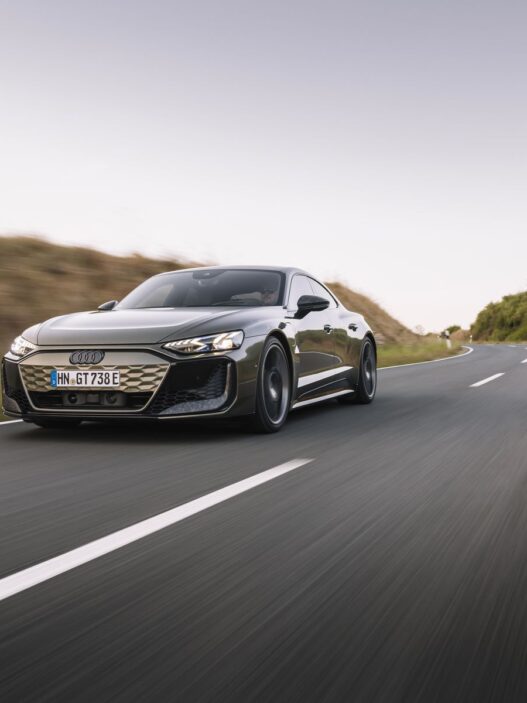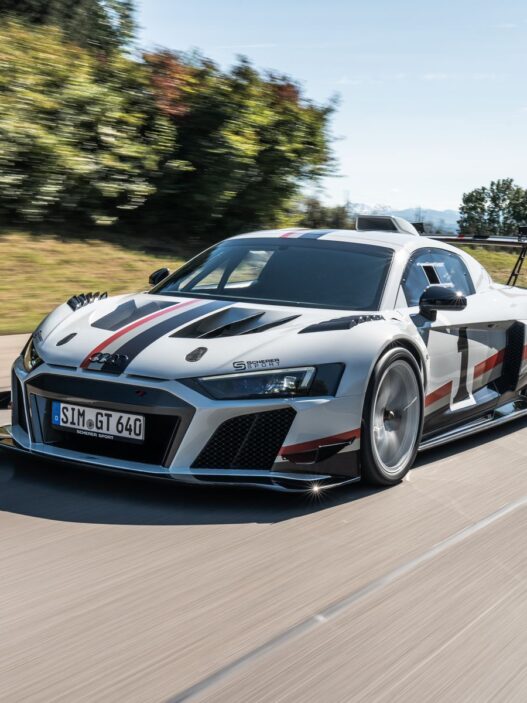


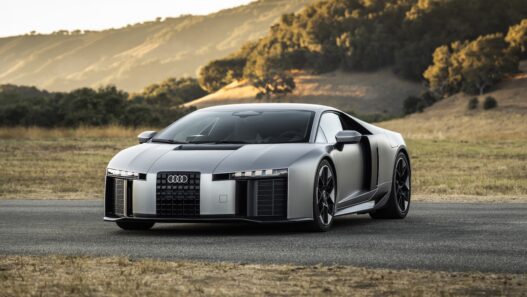





Every family has one relative who insists on wearing the more expensive version of everyone else’s outfit to the same party. The Audi Nuvolari is that relative, built on shared underpinnings with a sibling from Sant’Agata, dressed more dramatically, and priced at exactly double.
A Sports Car Borrowed From the Family
Audi had spent decades with genuine sports cars in its range, but both the TT and R8 were eventually discontinued for lack of demand, mirroring decisions at several rival brands. Unwilling to leave its sporting image empty-handed, Audi turned to sister company Lamborghini and reworked the Temerario into the Nuvolari — more powerful than the car it’s based on, and considerably louder in appearance. Only 499 will be built, at €590,000 each, roughly twice the price of the Temerario itself.

Design: Every Surface Has a Job
The Nuvolari’s S-shaped front air intake generates downforce, cuts lift at speed and helps cool the powertrain, while an extendable rear wing — the centrepiece of an active aerodynamics system — switches between closed, low-load and high-load settings. Gael Buzyn, head of Audi’s Advanced Design Center in Malibu, put it plainly: „Every exterior element fulfils a clearly defined aerodynamic function, from the front splitter lip to the rear diffuser. And everything is exactly what it looks like, whether carbon fibre or aluminium, inside and out.“

Power: A V8 That Didn’t Need the Help, and Got It Anyway
A 4.0-litre twin-turbo V8 alone produces 588 kW or 800 PS and 730 Nm of torque. Add three electric motors — one built into the dual-clutch gearbox, two on the front axle providing all-wheel drive, each contributing 110 kW or 150 PS — and combined output reaches 736 kW or 1,001 PS, with a stated system torque of 800 Nm. The result is a two-seater weighing 1,740 kilograms that reaches 100 km/h in 2.6 seconds and tops out at 351 km/h.

Battery: Ten Kilometres, on Purpose
A 7.4 kWh lithium-ion battery, tucked into the transmission tunnel, gives the Nuvolari an electric-only range of just 10 kilometres, with charging capped at 7.4 kW. That figure would sink an ordinary plug-in hybrid’s reputation; here it’s simply not the point. The battery exists to feed the electric motors quickly and capture energy under braking, not to cover distance silently. Official consumption figures haven’t been published yet.

On Track: Built for Laguna Seca, Not the Commute
A predictive chassis system reads steering angle, acceleration, yaw rate and grip several times a second, distributing torque, brake force and aerodynamic load accordingly. Ten-piston front brakes and four-piston rears handled hard stops on Laguna Seca’s circuit, while the Nuvolari, despite all-wheel drive and near two-tonne weight, turned in with unexpected lightness. The rear wing rises in Dynamic, Dynamic+ and Track modes and flattens on straights for top speed, backed by a Formula 1-style Drag Reduction System operated from a steering wheel button.

Verdict: A Sibling Worth Knowing, Not Worth Doubling Up On
The Nuvolari’s strengths are considerable: genuine performance gains over its donor car, distinctive styling, and a rarity that 499 units guarantees. Its weaknesses are just as plain: an unpublished consumption figure, a token electric range, and a price that doesn’t rationally track the improvements over its Lamborghini relative. Like that relative at the party in the pricier outfit, the Nuvolari isn’t dressed up because it needed to be. It’s dressed up because someone decided the occasion demanded it.