






Some ideas arrive exactly on time. Others show up to a party thirty years before anyone else does, get told to go home, and only find out decades later that the party eventually happened without them. The Porsche 968 CS Cabriolet is the second kind of idea.
A Concept Nobody Wanted in 1993
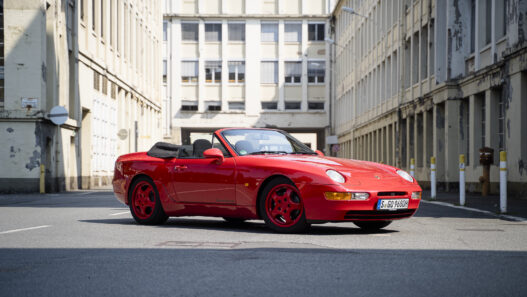
Porsche built exactly one 968 CS Cabriolet, a red prototype combining the stripped-out Clubsport philosophy with an open roof. At the time, the pairing made little sense to anyone: a convertible was for cruising, a Clubsport was for track weekends, and combining the two felt contradictory.

The regular 968, meanwhile, was the most refined version of a front-engined, rear-transaxle family dating back to the 924 in 1976, powered by a 3.0-litre four-cylinder producing 240 PS and 305 Nm of torque — a genuinely strong output for 1992.
Inside: Built to Be Driven, Not Lived In
Step inside and the bucket seats, sourced from an era before multi-way electric adjustment, make the point immediately. There’s little padding, little sound insulation, and almost nothing resembling modern comfort features.

The engine, by contrast, announces itself with real mechanical character rather than a refined turbo whisper — valvetrain noise, intake resonance, a heavy four-cylinder thump that feels closer to a small rhythm section than a string quartet.
A Weight Contradiction That Works
The standard 968 CS shed around 50 kilograms compared with the coupé by removing rear seats, electric windows, central locking and sound deadening, alongside a 20-millimetre lower ride height, 17-inch Cup wheels and lightweight seats borrowed from the 911 Carrera RS.


Removing the roof for the Cabriolet worked directly against that diet: extra structural bracing added roughly 70 kilograms back. Two opposing engineering goals collided in one car — and on the road, the result doesn’t feel contradictory at all. Light but communicative steering, a long bonnet in clear view, and a front axle that turns in with a precision unusual for a front-engined Porsche this old, thanks to the transaxle layout balancing engine weight up front against gearbox mass at the rear.
No Modes, No Software, Just a Cable
There are no drive modes, no active exhaust, no configurable displays. The only thing resembling a performance setting is a mechanical cable running to the throttle body.

By modern standards the car isn’t fast, but that’s rather the point: the six-speed gearbox wants using, the engine wants keeping busy rather than revved out, and with the roof down, intake noise, road roar and wind turn every gearchange into something you feel rather than something a computer manages for you.
Why It Disappeared
Porsche was in financial difficulty in the early 1990s, and the 968 was underselling. A niche open Clubsport derivative for a tiny customer base didn’t fit the moment — especially with the Boxster concept already taking shape behind the scenes as the company’s future entry-level model.

A purist open two-seater below the 911 couldn’t also be a purist variant of the ageing 968; the Cabriolet would have driven straight into the Boxster’s territory. The prototype was shelved. Porsche built 1,538 regular 968 CS coupés. The Cabriolet never went further than this one red car.
Verdict: Right Idea, Wrong Decade
Three decades on, Porsche’s current line-up — the 718 Spyder RS, the 911 Speedster, the 911 S/T, and this year’s 911 GT3 S/C — reads like a rediscovered blueprint of exactly what this prototype tried to be: a serious sports car, roof removed, motorsport hardware left largely untouched, sold not as a lesser coupé but as a more intense one. The physics haven’t changed since 1993 — a closed car is still the more logical basis for outright dynamics. What changed is the customer, now willing to pay a premium for less rather than more. The 968 CS Cabriolet’s real flaw was never the car itself. It simply turned up to a party that hadn’t been invented yet, and nobody around at the time knew what to call it.