




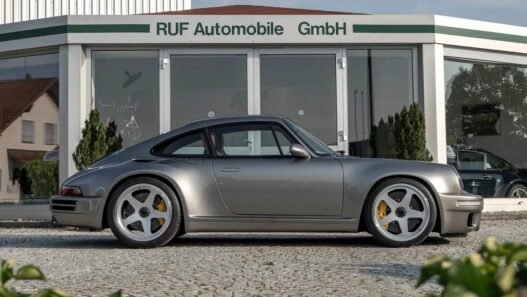


In 1987, a small workshop in the Allgäu sent a car down a Volkswagen test track fast enough to embarrass Ferrari, Lamborghini and Porsche in one afternoon. Nearly four decades later, that same company has built a new car that isn’t trying to beat that moment. It’s trying to stand next to it.
A Name Borrowed From a Test Track
The new Ruf Ehra takes its name from Ehra-Lessien, the Volkswagen proving ground where former Formula 1 world champion Phil Hill drove the legendary Ruf CTR, nicknamed the Yellowbird, to 339.8 km/h in 1987.

Ruf isn’t claiming a new record with this car. The stated top speed is 340 km/h, a number that reads less like ambition and more like a quiet nod to where it all started.
Not a Restomod, a Manufacturer
Unlike the growing list of companies reworking old 911s under their original chassis numbers, Ruf Automobile has built genuinely independent cars since 1981, each carrying its own chassis number beginning with W09.

The Ehra continues a shift that began in 2007 with the CTR3, whose rear end departed from Porsche architecture while the front still leaned on it, and completed in 2017 with the CTR Anniversary, which used no Porsche components at all. The Ehra follows that same independent blueprint.
Wider, Lighter, Still Handmade
Compared with the CTR Anniversary, the Ehra has grown noticeably wider — 58 millimetres more at the front, 54 at the rear — yet a carbon fibre body over a light monocoque keeps weight to just 1,325 kilograms.


New front and rear styling and large side air channels handle cooling and high-speed stability, backed by a deployable carbon rear spoiler rather than a fixed wing. Double wishbones with horizontally mounted pushrod dampers sit at all four corners, and new five-spoke centre-lock wheels finish the look.
Power Without a Dual-Clutch Box
A 3.6-litre twin-turbo boxer engine produces 478 kW or 650 PS and 900 Nm of torque, reaching 100 km/h from a standstill in 3.3 seconds.

What sets the Ehra apart from a factory 911 Turbo isn’t just the number, but how it reaches the road: a Ruf-developed variable all-wheel-drive system that can be switched off entirely, paired with a manual seven-speed gearbox rather than the dual-clutch automatics common in this class.
Independence, Not for Sale
Ruf’s timing has drawn attention beyond the car itself. Reports emerged that new Porsche chief Michael Leiters had approached Singer Vehicles about an acquisition, only for the American restomod specialist to show no interest, before reportedly turning to Ruf instead. Alois Ruf, the company’s 76-year-old head, responded with a public statement: „RUF is not for sale, and reports suggesting otherwise are false. RUF Automobile remains proudly family-owned and operated, as it has throughout its history.“ No price has been announced, and it remains unclear whether the Ehra will be built in limited numbers. What is confirmed: it won’t appear on a Porsche showroom floor.
Verdict: A Legend Revisited, Not Chased
The Ehra doesn’t try to outrun its own history, and that restraint is precisely what makes it convincing. Strengths are clear: genuine independence down to the chassis number, a serious 650 PS analogue drivetrain, and a name that honours a real achievement rather than inventing a new one. Gaps remain just as real — no confirmed price, no clarity on production numbers, and a car that, by design, most buyers will never get near a dealership to see. Like the ghost it’s named after, the Ehra doesn’t need to win. It just needs to still be standing there.